
On Nov 9, 2026, PwC said it will spend more than $100 million to put 85,000 people through a new Critical Thinking & Judgment Certificate.
All four of the Big Four have been called out this year for client reports and research full of AI-made citations. But PwC’s stated reason is more interesting. Its chief people and inclusion officer said that as AI takes on foundational tasks, “some of the repetition that really helped our people to develop critical thinking and judgment just won’t be there.”
When I first saw the news, I thought it was quite silly. A certificate is a snapshot, and critical thinking is something you have to keep doing.
Then I dug into the program. It’s mostly practice: a thinking-style diagnostic, realistic simulations, an AI coach, and an assessment at year-end. That’s the right approach. Daniel Willingham’s research says people can’t apply thinking advice they’ve memorized without practice and knowledge of the domain.
I’m hearing a version of this from clients. They spent the last two years getting people to use AI. Now they’re living with what it produces. A director at a large tech company told me he is increasingly overwhelmed with AI slop. It masks itself as a recommendation, and he has to spend time sifting through it to see if the work was done.
That’s cognitive surrender. I say a version of this to my own team all the time: if you can’t defend it, don’t send it.
I’ve been reading the Dune books. Frank Herbert saw this coming in 1965:
“Once men turned their thinking over to machines in the hope that this would set them free. But that only permitted other men with machines to enslave them.”
In his story, people didn’t just ban the thinking machines after the war against them. They built schools to train human minds to do that thinking again. That’s PwC’s bet.
It’s ours too. We built our Seek-Sense-Ship framework with tech companies that adopted AI early. Today I want to use it to answer the question that seems to be on everyone’s mind:
How do we help people use AI to produce better work without outsourcing their judgment?
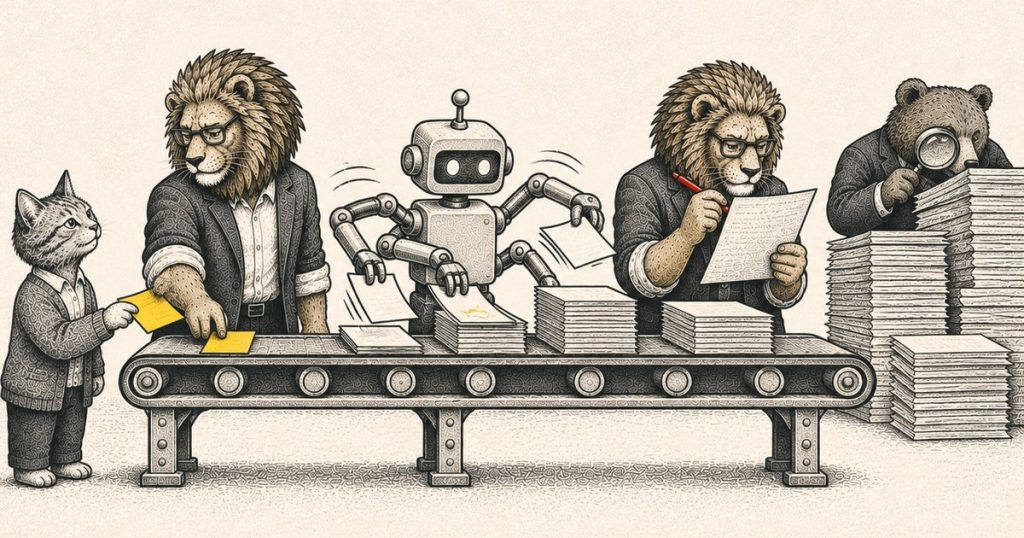
Give AI the middle of the work and keep both ends. Here are 12 principles for answering this question:
Seek: bring AI what it can’t see
- Assume AI is missing information. Your map of reality includes this morning. AI’s doesn’t. Your job is to find what it’s missing and hand it over.
- Talk to humans. Ask the people closest to the problem what they’re seeing. Dialogue surfaces what no prompt will.
- Look for outliers. We’re taught to throw outliers out so the data looks clean. AI predicts from patterns, so it does the same. But the exception is often the first sign a pattern is breaking, and Angus Fletcher argues humans are built to spot this kind of exceptional information.
- Steelman the other side. Find the smartest person who disagrees with you and argue their case until they’d sign it. Then ask AI to do the same.
Sense: hand over the work, keep the judgment
- Offload the processing. Searching, drafting, organizing, synthesizing, even remembering. AI is way better at these than we are. Spend the time you get back on the rest of this list.
- Hand over the intent, not the method. Be crystal clear about the outcome you want, and let AI find routes you’d never have thought of.
- Set specific, ambitious goals. Specific, difficult goals consistently beat “do your best”. The same goes for AI. Ask for more than you think it can do. Felix Rieseberg at Anthropic has a practical tutorial.
- Design evals. Write down what good looks like as a few pass/fail checks, so AI can grade its work against your standard. My friend Mike Taylor shows how to build your own.
- One thread at a time. It’s tempting to set one agent off and spin up another for your next idea. Do that and you lose track of what each one did and why. Margaret-Anne Storey calls that cognitive debt.
Ship: put your name on it
- Trust but verify. Before anything goes out, go to the source for every claim AI gave you and read it until you understand it. Addy Osmani, now on Anthropic’s Claude Code team, has a good list of questions to run on AI output.
- Trust what makes you unique. AI pulls toward the average. It’s a probabilistic model. When you take the work to other people, bring your own ideas and say it in your own voice.
- If you can’t defend it, don’t send it. Picture the person who has to act on it asking “why?” three times. If you can’t answer, keep working. That’s the difference between a recommendation and slop.
Why the ends matter most
AI is strongest in the middle, at Sense: processing large amounts of data far faster than we can. So that’s where it’s easiest to hand over your judgment without noticing. The Sense principles are about handing over the work and keeping the judgment.
The ends are yours. The decisions your team brings you rarely come with much data, so someone has to go find what AI can’t see. And someone has to put their name on the result. Skip both, and you get what that director is sifting through: slop dressed up as a recommendation.
Email me the principle I missed.
Go deeper
Your Brain on ChatGPT (Kosmyna and colleagues, MIT Media Lab, Jun 2025)
- 54 people wrote essays with ChatGPT, with a search engine, or with nothing. Brain scans showed the ChatGPT group had the weakest brain connectivity, and many couldn’t accurately quote the essay they had just written.
- Effort ≈ 3 min for the abstract (the full paper is long)
To Trust or to Think (Buçinca, Malaya and Gajos, 2021)
- 199 people made decisions with help from an AI. Designs that made them think before accepting its suggestion cut overreliance, but people liked that user experience the least. That’s why cognitive surrender is so easy.
- Effort ≈ 3 min for the abstract
Critical Thinking: Why Is It So Hard to Teach? (Daniel Willingham, Arts Education Policy Review, 2008)
- Written for teachers, and it applies to every corporate training program. Willingham’s case is that critical thinking “is not a skill” you learn once and use anywhere. It depends on domain knowledge and practice. Read it before you buy a critical thinking course.
- Effort ≈ 25 min read (13 pages)
This essay first went out in my 3-2-1 newsletter on Nov 15, 2026. Subscribe here to get the next one.
Andrew Barry is the founder and CEO of Curious Lion.

