
The loop and the map
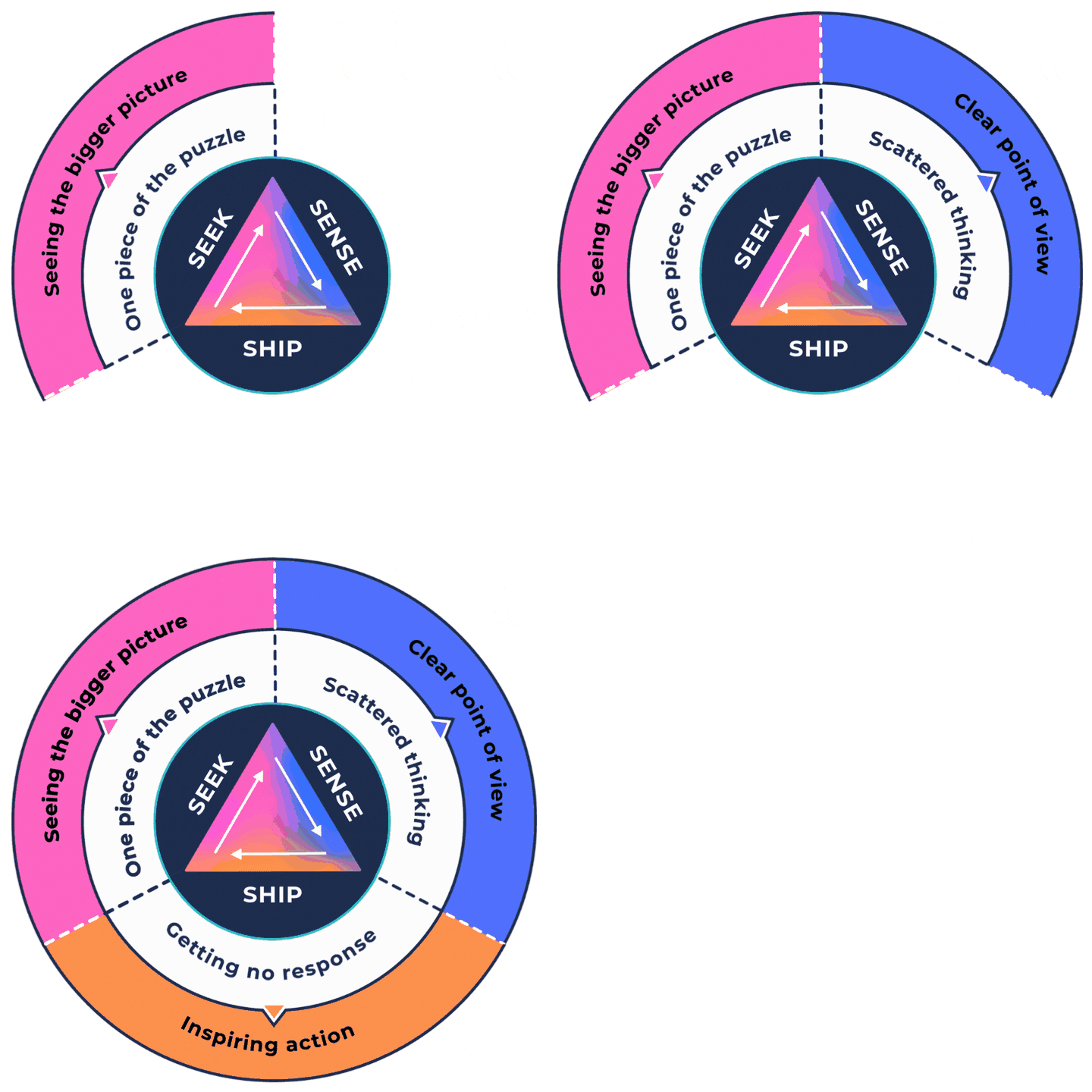
The curriculum teaches one loop: Seek, Sense, Ship. Judgment is what the loop produces: someone who can take ambiguity and raw information and drive it to a decision others will act on.
Each motion breaks into three capabilities, and each capability has named tools. The curriculum ships as three core modules, one per motion, opened by an activation session that shifts the mindset.
Anatomy of a module
A module covers one motion: a live deep-dive session, a practice lab, and everything around them. When you license a module, your team receives a complete delivery kit, built so a certified coach can run it on their first delivery.
The facilitator guide
The session design, timed to the segment. Each section carries a section message, the one thing that section must land, and key points with several ways to deliver each one: a story, a discussion, an exercise, a share. Stretch prompts serve advanced groups.
The session deck and breakout materials
The presentation for the live session, built to run in person or virtual.
Participant materials
A workbook holding the tools, worked examples, and the supporting reading. Licensed per person: the facilitator kit carries a specimen set, and every learner’s own copy comes with their seat.
The practice design
Learning circles: small cross-functional groups working live problems each person brought, with full debrief notes for the coach.
Reinforcement assets
Refresher material and the AI companion, carried on the reinforcement platform. This is what keeps the tool in reach after the sessions.
Measurement hooks
Each module maps to three of the nine measured capabilities. The instruments in the measurement framework rate exactly those, so a module’s effect shows up in the data.
Version control
Every kit is versioned and every release ships with a change log. Updates flow through the platform as the methodology evolves, and staying current is a condition of the license.
The facilitation checklist
What a coach runs the day before: room or platform setup, materials, breakout assignments, the timing plan.
One module in depth: Seek
The clearest way to understand a module is to walk one. Here is the Seek deep dive, which teaches the questioning discipline the rest of the loop depends on.
The premise: two people leave the same meeting with different pictures of what happened. Attention filters through goals and past experience, and people construct meaning before they notice they are doing it. The gaps this creates are invisible, and direct questions do not surface them. The session teaches a tool that does.
Open on the gap
The room studies the same image and lists what they saw. Then everyone reads what the others noticed. The lists barely overlap, which makes the module’s premise visible before anyone names it. The facilitator sets the stance: detectives of objective reality.
Why direct questions fail
Ask an abstract question and you get an abstract, rehearsed answer. Ask for the story and you tap episodic memory: specific detail, real sequence, things the person did not know they knew. The quality of what you hear is set by the form of what you ask.
How and What questions
Three rules. Delay why as long as you can; why puts people on the defensive before they have told you anything. Start the first three or four questions with how or what. Use what-if to invite stories about futures that have not happened yet.
The Loop for Understanding
Paraphrase back what you heard and ask: “Did I get that right?” Slightly wrong works better than exactly right. People cannot help correcting information about themselves, and the correction carries more than the confirmation. The guide has the coach name that mechanism out loud, so participants risk an imperfect paraphrase instead of holding out for a perfect one.
Practice, in pairs
Ten minutes each way: find the why behind a partner’s hobby using only the tool. Scored: one point for confirming a reason the partner already knew, two for surfacing one that is a revelation to the partner themselves. Then a live work situation, with the questioner working to surface what is missing, what is assumed, and what to learn before deciding. Manager cohorts run this round on a real direct-report situation brought from prework.
Close on the rhythm
Participants leave with a four-beat rhythm: pause, ask, listen, loop. And with the reason to keep using it: good questions build a shared frame of reference, so the next time that person reacts to your work, they react from inside an understanding you built together.
What the facilitator holds
The guide carries the timings, the section messages, and several delivery options for every key point. A coach with a quiet group runs the exercise; a coach with a talkative one runs the discussion. The certification course trains exactly this: choosing well in the moment, then debriefing so the learning transfers.
What participants leave with
A rule set they can run the next morning. One live conversation already rehearsed in the practice round. A workbook with the tool, the worked examples, and the supporting reading. And the four-beat rhythm, which is the whole tool in four words.
What the AI companion reinforces
Afterward, a participant brings a live problem or an upcoming conversation to the AI companion. It walks them through the motion: what do you know, what are you assuming, what would you ask, how would you phrase it. It asks rather than answers, on purpose. And it is there in the week the real conversation happens, which is when a refresher matters.
Deliverables inventory
Everything below is our side of the responsibility split. You bring the strategic vision, the LMS or LXP, the build team, the measurement strategy, and the rollout. The License and Certify page covers that split in full.
| Layer | What your team receives |
|---|---|
| Content and toolkit | The full kit for every licensed module: timed facilitator guides, session decks, breakout materials, participant workbooks with worked examples, and facilitation checklists. Facilitator kits carry a specimen set of participant materials; each learner’s own set comes with their seat. |
| SCORM-compatible assets | The self-paced layer, packaged for your LMS or LXP: short video explainers and worked examples that move the teaching out of the live room, so live time goes to practice. |
| Measurement framework | The instruments and rubrics: pre and post assessment across the nine capabilities, the manager rating instrument, and application tracking that follows tool use on real work. Adopt it whole or fold it into your own measurement strategy. |
| Comms and reinforcement assets | Launch comms for leaders and participants, refresher material, and the AI companion, all carried on the reinforcement platform and updated by us. |
| Implementation guidance | Rollout design from pilot through sustain, certification for your coaches, an observed and debriefed first delivery for each of them, and support to embed the practice in the flow of work. |
On updates: every asset is versioned and every release ships with a change log. Updates flow through the platform as the methodology evolves, and staying current is a condition of the license. Your coaches never teach from a stale kit.
How modules assemble into pathways
Modules assemble into pathways: cohort programs that run two to three months, designed and built with your team during the rollout’s Design and Build stages.
Activate
A two-hour live session for whole populations, run per timezone. Shifts the mindset from “my view is complete” to “my view is partial.”
Seek module
Deep dive plus learning circle. The questioning discipline: How and What questions, the Loop for Understanding.
Sense module
Deep dive plus learning circle. From many inputs to one insight: MECE, the Problem Pyramid, top-down communication.
Ship module
Deep dive plus learning circle. Landing the decision: perspective shifting, the Perspective Hook, curse of knowledge checks.
Reinforce
The platform, the AI companion, and the cohort community carry the practice after sessions end.
Between sessions, participants work the tools on problems from their own desks, with the self-paced assets carrying the teaching so live time goes to practice.
What flexes
- Sequence and pacing, fitted to your calendar
- Audience: IC and manager variants of every module
- Delivery mix: in person, virtual, or both
- Vocabulary: modules can carry your organization’s language for the three motions
What holds
- Activation before the toolset: mindset first, always
- Cohort learning, cross-functional by default
- Live practice on real, unresolved problems: sessions are the work
- Reinforcement after: platform, AI companion, community
Measurement, briefly
Five layers, from perception to business outcome. The full framework, instruments included, is part of the license.
| Self | Pre and post self-assessment across the nine capabilities, returned to each participant as a spider chart |
| Manager | The participant’s manager rates the same nine capabilities, which surfaces the blind spots a self-rating cannot |
| Application | Concrete examples of tools used on real work after the program, tracked tool by tool |
| Network | Growth in working relationships across functions inside the cohort |
| Impact | Business outcomes over a longer horizon: retention, engagement, promotion rates |
The capability diagnostic in the initial engagement produces the baseline for the self and manager layers, so measurement starts from real data rather than from a survey nobody remembers taking.
Where the commercial model lives
This pack covers the curriculum and the deliverables. Seats, coach certification, cost parameters, and the rollout sequence live on the License and Certify page.
See the licensing model